
PACKAGING FORMATS

Sachet Packaging.

Understand sachet seals, dimensions and opening options before choosing a machine or ordering film.
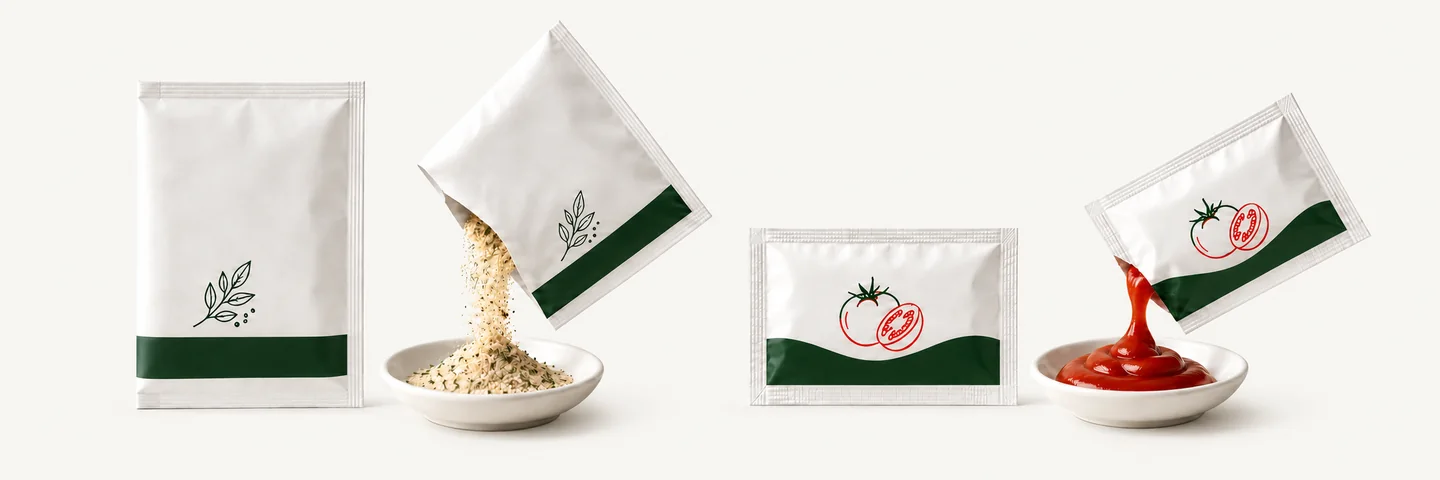
Illustrative three-side-seal seasoning sachets pouring powder and short four-side-seal ketchup sachets dispensing sauce

Illustrative pack format · not a production drawing

01 / UNDERSTAND THE FORMAT

What Is a Sachet?

A sachet is a small flexible pack, commonly used for a single serving or a sample. Here, we focus on flat three-side-seal and four-side-seal sachets. Check the finished seal layout—not just the name or proportions of the pack.

Three-side-seal sachet with one folded edge The left edge is a fold. Green shaded borders show the top, right and bottom heat seals. The fold may be in another position on a different machine layout. Fold Seal 3-SIDE SEAL
One folded edge · three sealed edges

Three-Side-Seal Sachet

A single web can be folded to form one closed edge, with the other three edges sealed. The fold is shown on the left here; its position depends on the forming layout.

Four-side-seal sachet Green shaded borders run around all four edges of the front and back panels. Two film faces do not necessarily mean two supply reels. Seal 4-SIDE SEAL
Front and back panels · four sealed edges

Four-Side-Seal Sachet

The front and back film faces are sealed around all four edges. Depending on the machine, these faces can come from a single reel or separate reels. Confirm the film path before specifying rollstock.

Simplified finished-pack schematics · no dimensions or production tooling implied

Why can “three-side seal” mean something different on a pouch quotation?

Some premade-pouch suppliers use the term for a pouch supplied with three edges sealed and one left open for filling. Ask whether the term describes the supplied empty pouch or the finished, filled pack. Share front-and-back photos and identify the folded and sealed edges.

Sachet, Stick Pack or Pillow Bag?

Flat sachet

Typically has three or four perimeter seals. A folded edge replaces one seal in the three-side-seal example above.

Stick pack

A typical narrow tubular pack has a longitudinal back seal and two end seals.

Explore stick packs

Pillow bag

Typically has a longitudinal back seal and two end seals, with a pillow-like body when filled.

Explore pillow bags

Names can overlap between suppliers. A fixed width or length-to-width ratio does not reliably identify the format.

02 / SIZE YOUR SACHET

Sachet Dimensions, Fill Space & Film Layout

Start with the finished sachet’s outside width and length. The seals are included in those measurements; the space inside them is smaller. Confirm the fit with your actual product before ordering printed film.

Outside sachet dimensions and space between seals A simplified four-side-seal sachet. W spans the outside cut edges horizontally and L spans them vertically. The dashed inner rectangle shows the flat area between the seal inner edges, not a volume or a filling level. Green borders represent seals. W · Outside width L · Outside length Space between seals Flat area ≠ fill volume Seal Four-side-seal example · not to scale
Illustrative geometry · not a production drawing or capacity guide

Measure the pack, then check the fill.

Outside size
Measure an empty sachet laid flat, cut edge to cut edge: width × overall length. If you send a filled sample, say that it is filled.
Seal space
Measure between the inner edges of the seals. On a three-side-seal sachet, locate the fold separately; do not subtract a fourth heat-seal border.
Actual fill
Allow for the product’s volume, the filled shape and clearance to close the pack. Net weight alone does not establish a sachet size.

WORKED EXAMPLE / CENTRE-FOLDED FILM

From 16 cm Film to an 8 × 10 cm Sachet

This reference uses one film web folded at the centre, bringing the front and back panels together. The fold forms one closed side; the other side and the top and bottom are sealed.
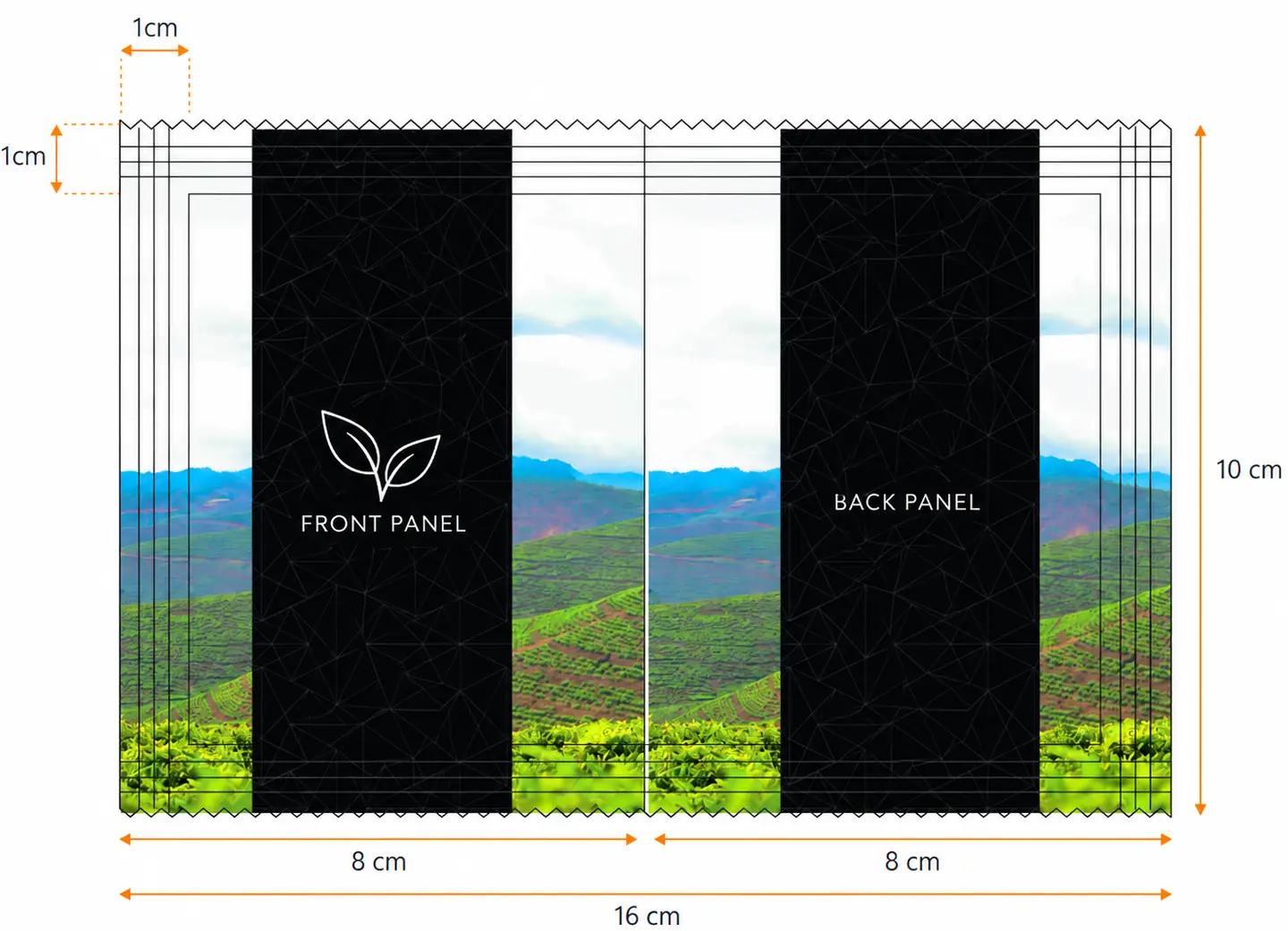
Unbranded film reference: total width 16 cm, front and back panels each 8 cm, overall height 10 cm and two 1 cm edge annotations
Unfolded film layout16 cm total width = 8 cm front + 8 cm back. Select to enlarge.
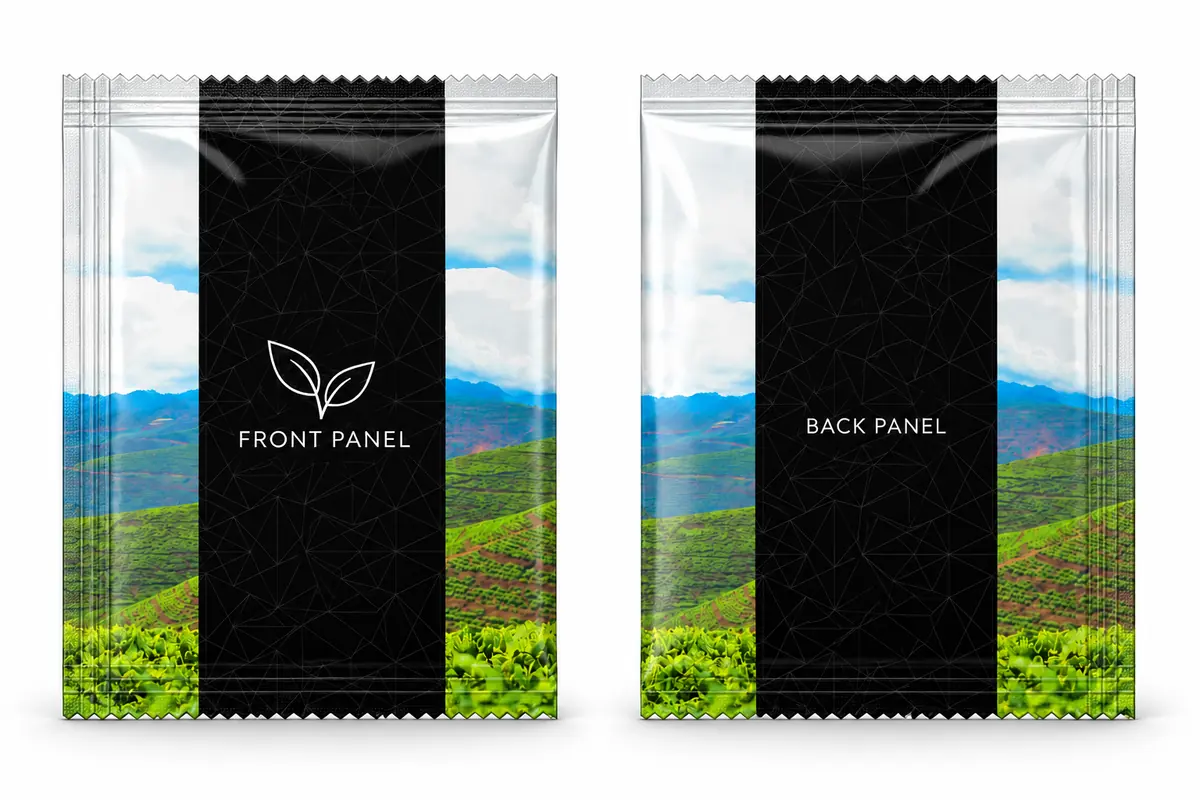
Illustrative front and back of one three-side-seal sachet using the unbranded reference artwork; front has a folded right edge and sealed left, top and bottom edges
Illustrative finished sachet · front and backApproximately 8 × 10 cm outside size. The smooth fold changes sides when the pack is turned over.
How the folded-film example works

01 / Fold the two faces togetherIn this layout, 16 cm ÷ 2 gives an 8 cm outside pack width. This is a folded-web example, not a film-width formula for every sachet machine.

02 / Keep the seals within the outside sizeThe 10 cm dimension is the overall top-to-bottom size shown. Do not add the top and bottom seal areas again. Measure the space inside the seals separately.

03 / Confirm the marked edge zonesThe reference includes 1 cm annotations. Confirm whether each marks a seal, artwork clearance or another allowance before calculating usable space or ordering film.

Unbranded reference layout and illustrative mockup—not a released production drawing or a confirmed fill capacity. No grams or mL are assigned. Final web width, seal positions, cutting and registration must match the selected machine.

What changes the space you need?

Powders & granulesShare the target weight, bulk density if known, flow behavior and particle size. A different powder can occupy a different volume at the same weight.

Liquids & pastesShare the target volume or weight, filling temperature, viscosity and any particles. Check the filled shape and how the product pours or squeezes out.

Confirm the Film Layout Before Printing

There is no single sachet film-width formula. The finished pack, forming direction and supply arrangement must be reviewed together.

One reel or two? Confirm how the film faces meet.

A folded web can create a three-side-seal sachet. Other systems slit a single reel into two webs or feed separate reels to create the front and back faces. Two film faces do not automatically mean two reels. Confirm the machine layout, lane arrangement, slitting and trim before specifying the total web width.

Does print repeat equal the finished sachet length?

Not always. Repeat is measured along the film’s travel direction. Its relationship to finished width or length depends on the forming layout, artwork repeats and cutting arrangement. Agree the repeat pitch, eye-mark position and cut line together; the eye mark is not necessarily the cut line.

Already have a sachet or a roll of printed film?

Send front-and-back pack photos, outside dimensions, seal or fold positions, target fill and the film specification or layout if available. A similar appearance does not prove that the film will run on another machine. Representative product and film samples help define what needs testing.

Starting without final dimensions or artwork?

Begin with the actual product, target dose and a reference pack if you have one. Include the initial run size, number of SKUs and required output. Confirm the sachet and machine film layout before committing to production artwork or a printed-film order. Film-supply quantities and packing-service quantities are separate from equipment selection.

Before ordering: agree the finished pack, seal layout, total web width, repeat and cut positions with the machine team and film supplier. Material, sealant face, roll limits and unwind direction also require confirmation.

03 / PLAN THE OPENING

Choose How Your Sachet Opens

Consider where the tear starts, how it travels and how the product should come out. The cut edge, tear notch and film structure need to work together.

Straight and serrated cut edges shown as separate edge profilesStraight edgeSerrated edge

Straight or Serrated Edges

These describe the cut-edge shape. A serrated edge is different from a separate tear notch; the edge shape alone does not establish how easily the film will tear.

Illustrative side tear notch within a sachet seal borderTear notchDashed line: intended tear direction

Choose the Tear-Notch Position

A notch helps start the tear. Review its position against the seal border, product area and intended opening. The film affects how the tear continues after it starts.

Illustrative wider top opening and smaller corner opening for review with filled samplesWider top openingCorner opening

Match the Opening to the Product

For seasoning powder, consider how it pours. For ketchup or paste, consider squeeze control. Review the opening size and tear path with the actual film and filled samples.

Illustrative opening concepts only—not cutting specifications or a promise of easy opening. Confirm the film, notch and cutting arrangement with the machine team and film supplier.

What should I send for an opening review?

Send a reference sachet or a short opening video, the film specification if available, and explain how the product should be poured or squeezed out. Test the opening with filled samples before confirming the final design.

04 / YOUR QUESTIONS

Sachet Packaging Questions

Can you help me choose a sachet size for my target fill?

Yes. Share your product, target weight or volume, and a reference pack if you have one. We can review a suitable starting size around the product’s volume, flow behavior and required seal space. Confirm the final dimensions with filled samples before ordering printed film.

Can you check whether my existing printed film is suitable?

Yes. Send the film specification, total web width, print repeat, unwind direction and roll dimensions for review. Include a finished sachet or film sample if available. We will check these against the proposed forming and cutting layout; suitability for production needs confirmation with the actual film.

What should I prepare before ordering printed sachet film?

Prepare your product details, target fill and a reference pack or proposed dimensions. We can then review the finished pack and machine film layout with you. Before printing, agree the seal and fold positions, web width, print repeat, eye mark, cut line and unwind direction with the machine team and film supplier, and arrange representative samples for testing.

Should I keep the same sachet width across my products?

Yes. Where the products allow it, we recommend keeping a common bag width on both single-lane and multi-lane machines. On a single-lane machine, changing width may require a different forming set, a matching film width and adjustments to film guidance, sealing or cutting, depending on the design. Multi-lane machines also need the lane spacing and any slitting arrangement reviewed. Each change takes setup and sample checks, adding downtime and potential film waste. Share all required widths before machine selection so essential changes and suitable tooling can be planned.

Have a Sachet in Mind?

Share your product, target fill, bag dimensions and a reference photo. If you already have printed film, include its specification so we can review the pack and machine requirements together.

Review My Sachet Project
Scroll to Top