
PACKAGING FORMATS
Pillow Bag Packaging.
Understand the structure, film requirements and machine options for your product.
01 / UNDERSTAND THE FORMAT
What Is a Pillow Bag?
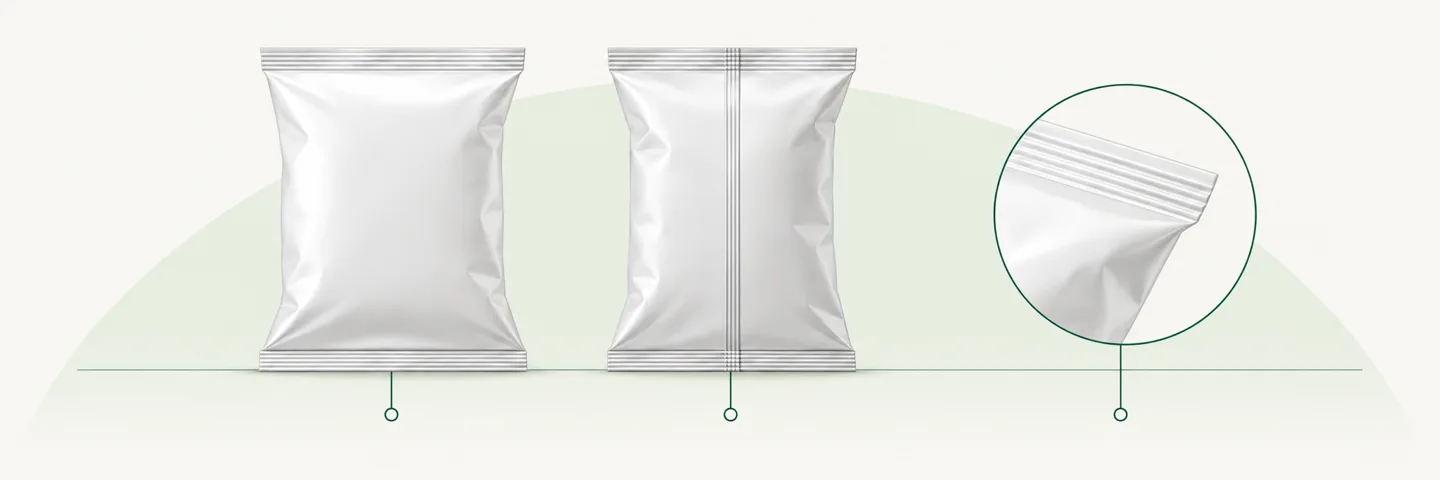
A pillow bag is a flexible pack formed from a continuous web of film, with one longitudinal back seal and two end seals. Also called a pillow pouch or pillow pack in flexible packaging, it takes on a pillow-like shape when filled. The name describes the pack format—not a particular film material or machine model.
01Pillow bag back seal: central or offset
The film edges join in a longitudinal seam along the back. A center-seal pillow bag places this seam near the middle; an offset back seal places it to one side. Seal position and seal construction are separate choices: a central seam does not, by itself, tell you whether it is a fin seal or a lap seal.
02End seals, bag length and flat width
Transverse seals close the top and bottom of the pack. Measure overall bag length from cut edge to cut edge, including the end-seal areas. Flat bag body width is measured across the laid-flat body.
03What machine makes a pillow bag?
Both vertical form-fill-seal (VFFS) machines and horizontal flow wrappers can produce pillow packs. VFFS forms a bag from rollstock as part of a vertical filling process; a horizontal flow wrapper forms film around products fed through the machine.
Start with the sample: identify the back seal, then record the overall bag length and flat bag body width.
Fin seal vs. lap seal: what is the difference?

Both close the longitudinal seam of a pillow bag. The difference is which film surfaces seal together.
Fin seal pillow bag
Inside to inside. A common choice for pillow bags made from laminates with an inner heat-seal layer. The outer surface does not need to seal to the inner surface. The two film edges form a fin that can fold against the bag.
Lap seal pillow bag
Inside to outside. Consider this when a flat overlapping back seam is preferred. It may reduce the film allowance used for the longitudinal seal, depending on the bag and seam dimensions. Both film surfaces must be compatible for sealing, and the machine must support the setup.
Seal strength, leak resistance and any film savings depend on the actual film, seam dimensions and sealing conditions; confirm them through sample testing.
02 / SIZE YOUR PACK
Pillow Bag Dimensions & Film Width
Start with the finished bag dimensions, then estimate the rollstock width. For a plain pillow bag without side gussets, keep the bag body width and the total back-seal allowance separate.

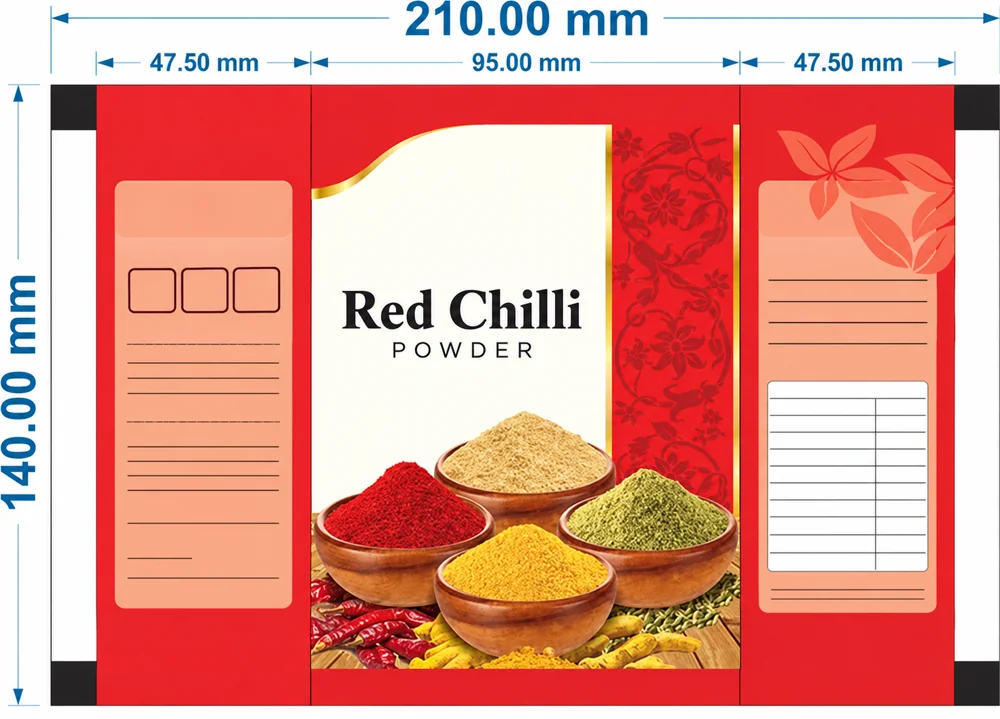
How to estimate pillow bag film width
F ≈ 2B + A
- F
- Unfolded film width across the web.
- B
- Flat bag body width, excluding a projecting fin.
- A
- Total back-seal allowance across both film edges—not one edge alone.
Illustrative calculation
If B = 150 mm and the agreed total allowance A = 20 mm:
2 × 150 + 20 ≈ 320 mm film width
How to read the pictured film layout
The picture shows 210 mm overall width and labelled panels totaling 190 mm (47.5 + 95 + 47.5). In this example, the remaining 20 mm represents the total back-seal allowance.
Does fin seal or lap seal change the allowance?
For a fin-seal estimate, A is the sum of both edge allowances (s + s). For a lap seal, A is the overlap width. Confirm the actual film drawing and equipment requirements before ordering.
How do you measure pillow bag length?
Measure L from one cut edge to the next, including the end-seal areas. Do not add the top and bottom seals again to a complete finished-bag length. The usable space between seals is a separate measurement.
Does print repeat equal bag length?
With one printed repeat per bag and no extra cut-out between bags, the print repeat can correspond to L. An eye mark helps register the print position; it is not necessarily the cutting line. Confirm repeat pitch, mark position and cut position together.
This estimate is for an ungusseted pillow bag. Gusseted formats and product-based flow-wrap sizing need a different dimensional review. Confirm the film drawing, forming parts and actual sample before production.
03 / PREPARE YOUR FILM
Packaging Film & Rollstock
Already have film for your pillow bag? Share the material specification and roll details so we can review the match with the proposed machine.
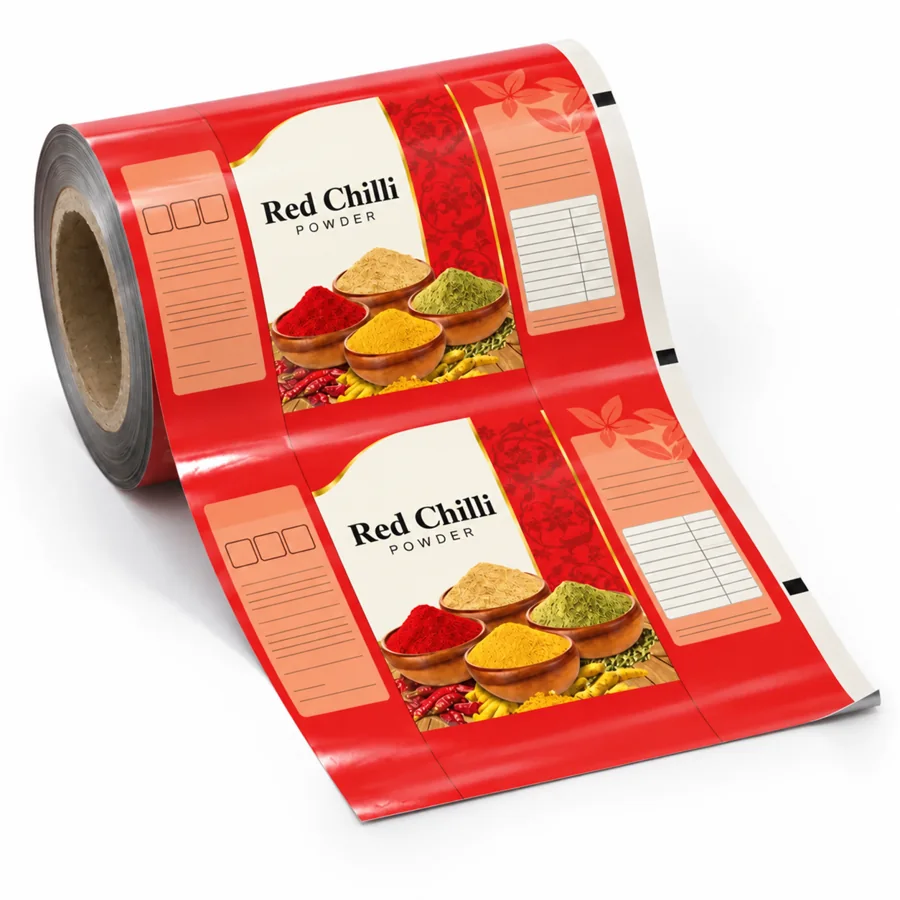
Before ordering: agree core ID, maximum roll OD, sealant face and unwind direction.
01 Roll core ID & maximum roll OD
Before the film is wound, confirm the core inside diameter required by the machine’s reel shaft, plus the maximum full-roll outside diameter and roll weight. These limits depend on the machine model and reel-holder configuration. A wider core is not automatically acceptable.
02 Which side is heat-sealable?
Ask the film supplier to identify the sealant surface, layer structure and total thickness. Do not identify the heat-seal face from its silver or clear appearance alone. Fin seals join inner to inner; lap seals need compatible inner-to-outer surfaces. Existing laminated film still needs review against the machine’s sealing system.
03 Is the roll wound the right way?
Confirm print wound in or out, the leading edge and which side carries the eye mark. Use a supplier unwind sketch with the actual machine web path; the print and sealant must arrive in the required orientation. Match the diagram, not just an unwind-number reference.
04 Will the machine read the eye mark?
Have the film supplier and machine team confirm mark size, contrast, edge position and spacing against the sensor arrangement. A visible black block alone does not prove compatibility. Include the print repeat and cut position on the film drawing so registration can be reviewed before printing.