
PACKAGING SOLUTIONS BY PRODUCT

Liquid & Paste
Packaging Solutions

Start with how your product flows—from water-like liquids and oils to viscous sauces, sticky pastes and recipes with particles. Viscosity, temperature, foaming and cutoff behaviour shape the filling and packaging route.

Filling method, output and repeatability are confirmed with the actual product, target dose and packaging material.
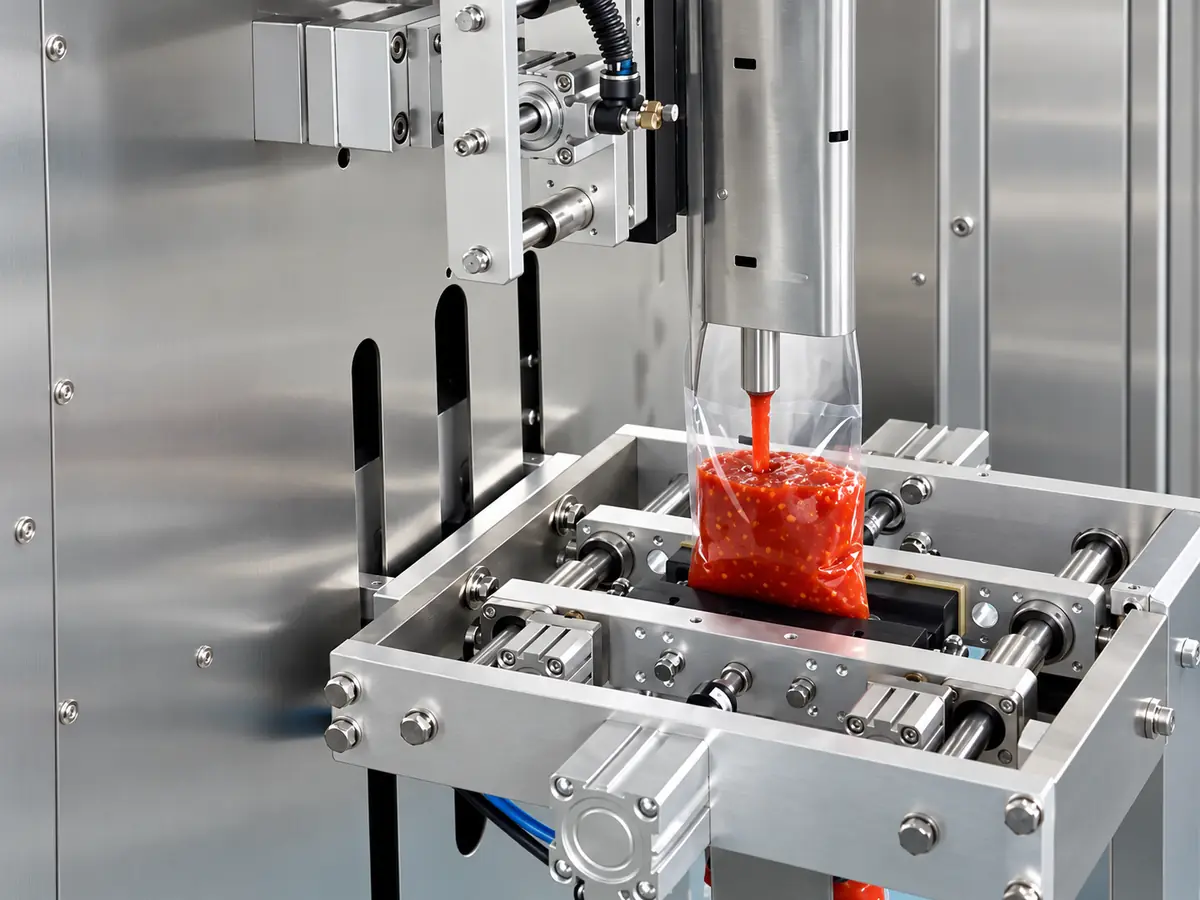
Red sauce being filled through a single nozzle into a transparent pouch on a stainless-steel packaging machine
01Free-flowingWater · oil · juice 02Viscous & stickySauce · honey · paste 03With particlesPulp · seeds · pieces

FIND YOUR PRODUCT & FILLING ROUTE

How should your liquid or paste be filled?

Choose the closest product group to see which filling routes should be evaluated. Viscosity alone is not enough—dose, particles, temperature, foaming, cutoff, cleaning and pouch opening also shape the liquid or paste packaging system.

Choose a liquid or paste product group and review its filling route

FREE-FLOWING LIQUIDS

For water-like liquids, control flow before the cutoff.

A liquid sachet packing machine or liquid pouch packing machine for water, juice, edible oil and other free-flowing products needs a filling route that can meter the target dose without uncontrolled flow, splash or late dripping at the pouch opening.

Product behaviour
Confirm whether the liquid is water-like, oily, volatile, aerated, foaming or prone to splashing.
Routes to evaluate
Gravity or timed-flow, piston, peristaltic or weight-based filling may be considered according to dose, product, pack and line design.
Control during filling
Nozzle position, flow stages, cutoff timing and pouch opening influence splash, drip and seal-area contamination.
Confirm with samples
Product sample, target dose, fill temperature, pack dimensions and required output range.

MACHINE IN THE VIDEO

Liquid stick pack filling and sealing

This 30-second demonstration shows an automatic liquid stick pack machine used for milk sachets. It provides a rollstock form-fill-seal reference for narrow liquid packs, including bag forming, liquid dosing, sealing and cutting.

The milk example does not confirm suitability for every free-flowing liquid, film or target dose.

PACKAGING FORMATS TO EVALUATE

Small sachets, retail pouches or a pourable spout format?

A liquid sachet packing machine can form compact packs from film, while premade and spout pouches support different presentation and dispensing needs. Confirm the dose, pouch opening, film or pouch structure, splash control and required output.

VISCOUS & STICKY PRODUCTS

For viscous products, move the dose and cut it off cleanly.

A paste filling machine or sauce pouch packing machine must be evaluated with the product at its actual operating temperature. Ketchup, mayonnaise, honey and syrup can resist inlet flow, trap air, cling to the nozzle or form a tail after the dose ends.

Product behaviour
Record whether it is smooth, shear-sensitive, sticky, stringy, temperature-dependent or likely to trap air.
Routes to evaluate
Volumetric piston or a suitable positive-displacement pump filling route may be assessed; very thick products may also need assisted supply to the filler.
Control during filling
Nozzle bore, suck-back or shutoff design, cutoff timing and product temperature influence tailing, dripping and fill stability.
Confirm with samples
Product sample, viscosity at fill temperature, target dose, pouch opening and proposed cleaning method.

MACHINE IN THE VIDEO

Compact VFFS for jelly liquid sachets

This demonstration shows a compact vertical form fill seal machine producing back-seal jelly liquid sachets. The sequence integrates film feeding, liquid dosing, bag forming, sealing, cutting and finished-pack discharge.

The jelly trial is a machine-route reference; viscosity, fill temperature, dose and cutoff still require sample testing.

PACKAGING FORMATS TO EVALUATE

Give the nozzle enough room for a controlled cutoff.

A sauce pouch packing machine must match the pouch opening or spout diameter to the product texture and nozzle. Sticky or stringy products may need more clearance and cutoff control to keep the seal area clean.

LIQUIDS OR PASTES WITH PARTICLES

For products with pieces, every passage must fit the solids.

A packaging machine for sauce with particles must handle both the carrier liquid and the solids. Pulp, seeds, vegetable pieces or meat pieces can settle, bridge a narrow passage, become damaged or reach the sealing area if the product path and pouch opening are not matched.

Product behaviour
Provide maximum particle size, shape, concentration, fragility and whether solids settle, float or separate.
Routes to evaluate
A large-passage piston, rotary positive-displacement, twin-screw, weight-based or application-specific route may be assessed from the real product.
Control during filling
Inlet, valve, pump cavity, hose, nozzle, pouch opening and spout diameter must be checked for clearance, damage and blockage risk.
Confirm with samples
Representative sample, particle range, solid-to-liquid ratio, target dose and acceptable particle damage.

MACHINE IN THE VIDEO

Chili sauce sachets with small particles

This automatic liquid packing machine fills and seals chili sauce containing fine solid pieces into three-side-seal sachets. It is a practical reference for matching the filling path and discharge opening to a sauce with small particles.

Maximum particle size, concentration, fragility and dose distribution must be confirmed with a representative sample.

PACKAGING FORMATS TO EVALUATE

Check every opening against the largest particle.

Packaging sauce with particles requires clearance through the complete product path, nozzle, pouch opening and any spout. A spout pouch should only be considered after its internal diameter and the real particle distribution are confirmed.

NON-FOOD LIQUIDS & GELS

For non-food products, start with formula and contact compatibility.

Detergent pouch filling, shampoo sachet packing and gel pouch filling should not automatically use the same contact parts or cleaning approach as food applications. Foaming, fragrance carryover, chemical compatibility and operator protection can change the required configuration.

Product behaviour
Confirm viscosity, foaming tendency, pH or chemical concerns, abrasiveness, fragrance, colour and operating temperature.
Routes to evaluate
Piston, diaphragm, peristaltic, rotary positive-displacement or weight-based filling may be considered only after formula and contact-material review.
Control during filling
Foam, vapour, splash, residue and fragrance carryover can affect nozzle motion, ventilation, cleaning and product changeover.
Confirm with samples
Safety data where applicable, sample, contact-material requirements, target dose, pack and cleaning procedure.

MACHINE IN THE VIDEO

Dual-output detergent doypack filling

This demonstration shows a dual-output premade pouch machine filling laundry detergent into doypack or stand-up zipper pouches and sealing the filled bags. It is a non-food reference for premade pouch opening, liquid filling and pouch closing.

Formula compatibility, foaming behaviour, contact materials and cleaning scope require project-specific review.

PACKAGING FORMATS TO EVALUATE

Match dispensing needs with formula compatibility.

Detergent, shampoo, liquid soap and gel may use sachets, premade pouches or spout pouches, but the packaging material, contact parts, foaming behaviour, closure and cleaning method require formula-specific review.

LIQUID & PASTE PACKAGING FAQ

Practical answers before you choose a filling and packaging route

Start with the product problem you need to solve. Each answer gives a clear first direction, followed by the product and pack details needed to confirm the machine.

Can one machine fill both thin liquids and thick sauces or creams?

Yes, but it may require a different pump, nozzle and product-feeding setup. A system that fills water, juice or shampoo successfully may not deliver the same result with mayonnaise, cream or thick paste. Viscosity at the actual filling temperature, dose range, product supply and refill time determine the workable configuration.

Compare liquid and paste product groups
Can the machine fill chunky sauce without filtering out the pieces?

Yes—if the largest pieces can pass through every product-contact passage without blocking the flow or unacceptable damage. Confirm the maximum particle size, solids concentration, particle fragility, product viscosity, valve opening, hose diameter and filling nozzle with a representative sample.

Why does a filled pouch look underfilled after the product settles?

Trapped air is often the cause; the delivered dose is not always actually too low. Air may enter during mixing, pumping or filling. When bubbles escape, the visible level drops. Check air pickup, agitation, product supply and filling conditions before simply increasing the dose.

Can dripping, stringing and pouch-mouth contamination be reduced?

Yes. The correct cutoff method, nozzle design, nozzle position and filling sequence can substantially reduce these problems. Depending on the product, the setup may use a shutoff nozzle, suck-back control, controlled nozzle movement or a slower final filling stage. The achievable result must be tested with the actual product and pouch.

Why does fill consistency change when product temperature or viscosity changes?

Because the filler must draw in and discharge the product under repeatable conditions. A colder or thicker batch may refill the dosing chamber more slowly, while a warmer product may flow and cut off differently. Stable temperature, consistent mixing and suitable product feeding help maintain repeatable filling.

Can foaming products such as detergent, shampoo or liquid soap be packed?

Yes, if foam control is designed into the filling process. Nozzle position, filling speed, flow stages, product drop distance and pouch headspace can all affect foam formation. Test the actual formula because products sold under the same general name can behave very differently.

Can one machine make sachets, premade pouches and spout pouches?

Usually not with one standard machine configuration. Rollstock sachets are formed and sealed inside a VFFS or sachet machine. Premade pouches require pouch feeding and opening, while spout pouches need handling matched to the pouch and spout structure. A dosing system may be adaptable, but the complete packaging routes are not automatically interchangeable.

What should I send before you recommend a liquid or paste packaging machine?

Send a representative product sample and the actual pouch or packaging film whenever possible. Also provide the product name, filling temperature, dose range, flow behaviour, maximum particle size, foaming or settling behaviour, pack dimensions and opening, required output, cleaning requirements and expected product changeovers.

Send your product and packaging details

CONFIRM WITH YOUR ACTUAL PRODUCT

Turn your product and pouch details into a workable packaging route.

Send a representative product sample, target dose, pouch or film specification and required output. We will review the filling method, product path and packaging-machine route together.

Request a Liquid & Paste Solution
Scroll to Top