
FINISHED FLEXIBLE PACKAGE HANDLING
Automatic Bag Sorting
& Counting Systems
Separate, space, orient and count finished bags, sachets, stick packs and other flexible packages before cartoning or downstream packaging. Each system is configured around the actual package format, product condition and required process.
- FINISHED FLEXIBLE PACKAGES
- SORTING, ORIENTATION & COUNTING
- DOWNSTREAM PACKAGING INTEGRATION
SYSTEM OVERVIEW
FINISHED FLEXIBLE PACKAGE HANDLING
A controlled handoff from finished bags to downstream packaging
Automatic bag sorting and counting systems are downstream handling equipment for finished flexible packages. They separate bags that arrive irregularly, create controlled spacing and orientation, then transfer counted packs to cartoning or another downstream packaging process.
Suitable applications can include finished bags, sachets and stick packs from an upstream packing machine. The required system layout depends on the actual pack format, surface condition, incoming flow and the count or handoff required by the next process.
Counting arrangements for sachets or bag groups are confirmed against the actual project.
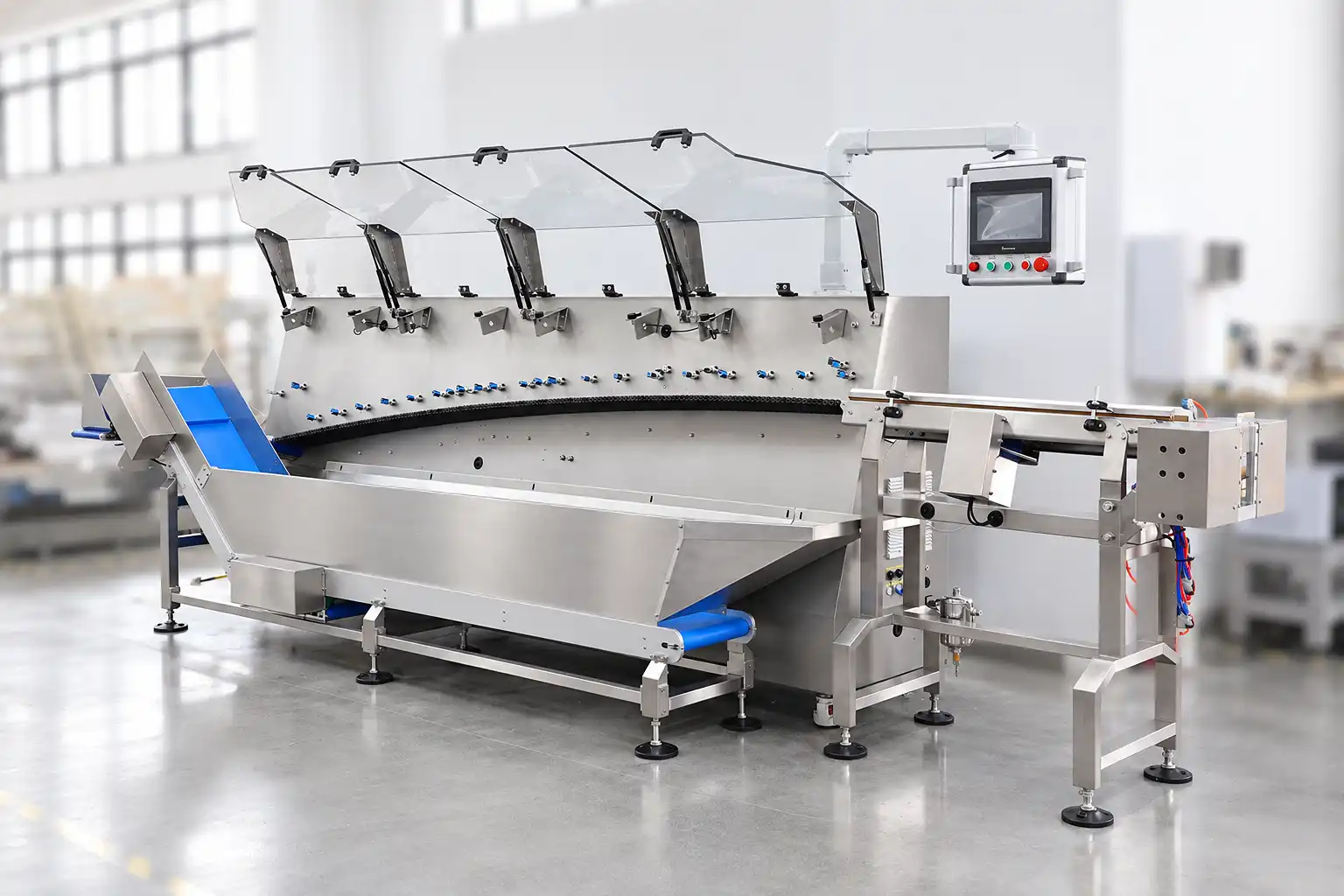
PACKAGE INFEED
Separate incoming packs
CONTROLLED TRANSFER
Space and orient the flow
COUNTED HANDOFF
Deliver counted groups
PROCESS PRINCIPLE
FROM UPSTREAM PACKING TO CONTROLLED DOWNSTREAM TRANSFER
How finished flexible packages move through the system
In a bag sorting and counting line, packages are fed from a hopper, then arranged, spaced, checked and transferred to the required downstream equipment. Each stage is configured around the actual package format and the next process.
STEP 1
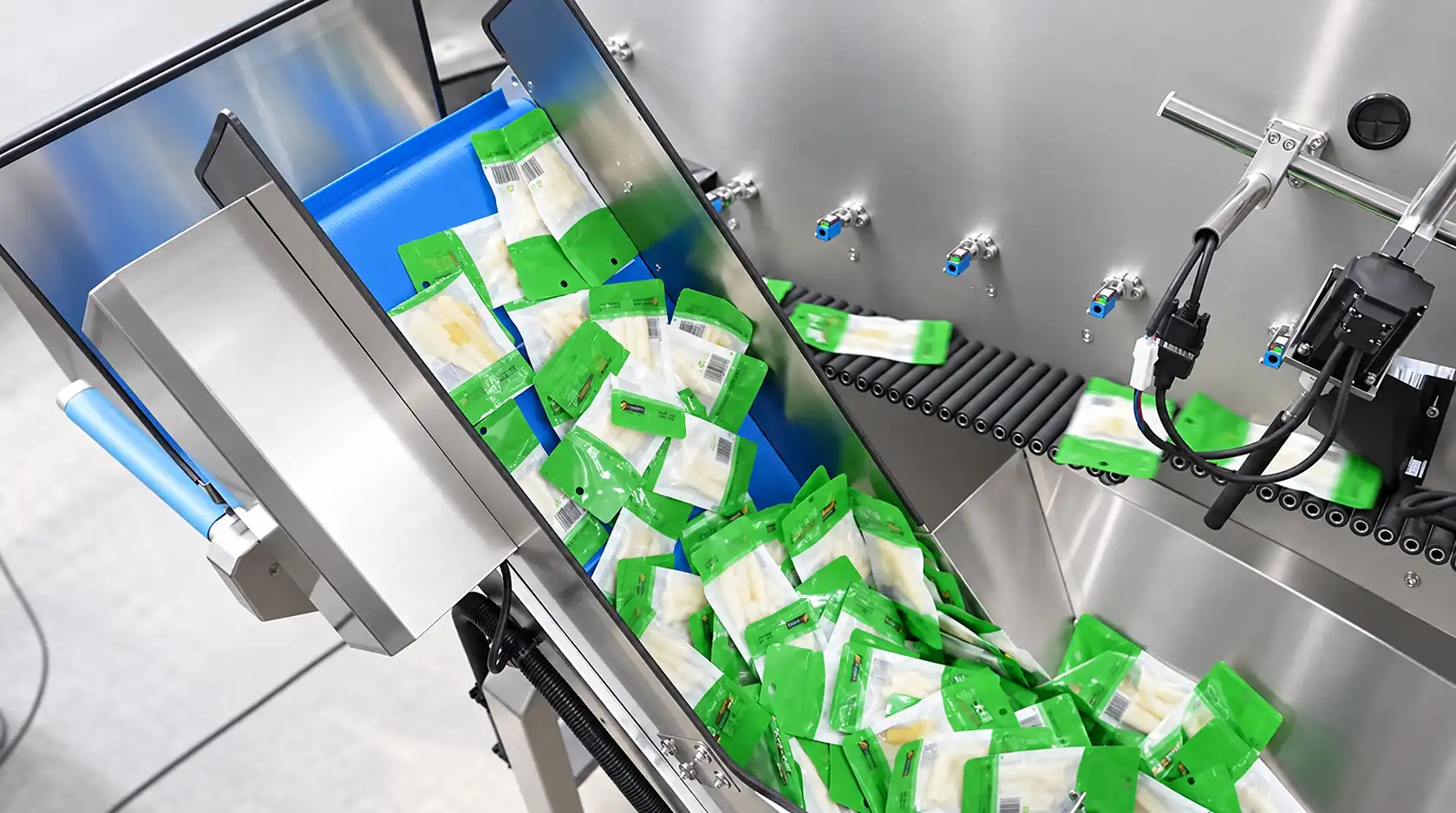
Hopper loading and automatic feed
Finished packages are loaded into the hopper. An elevator automatically transfers them to the sorting machine.
STEP 2
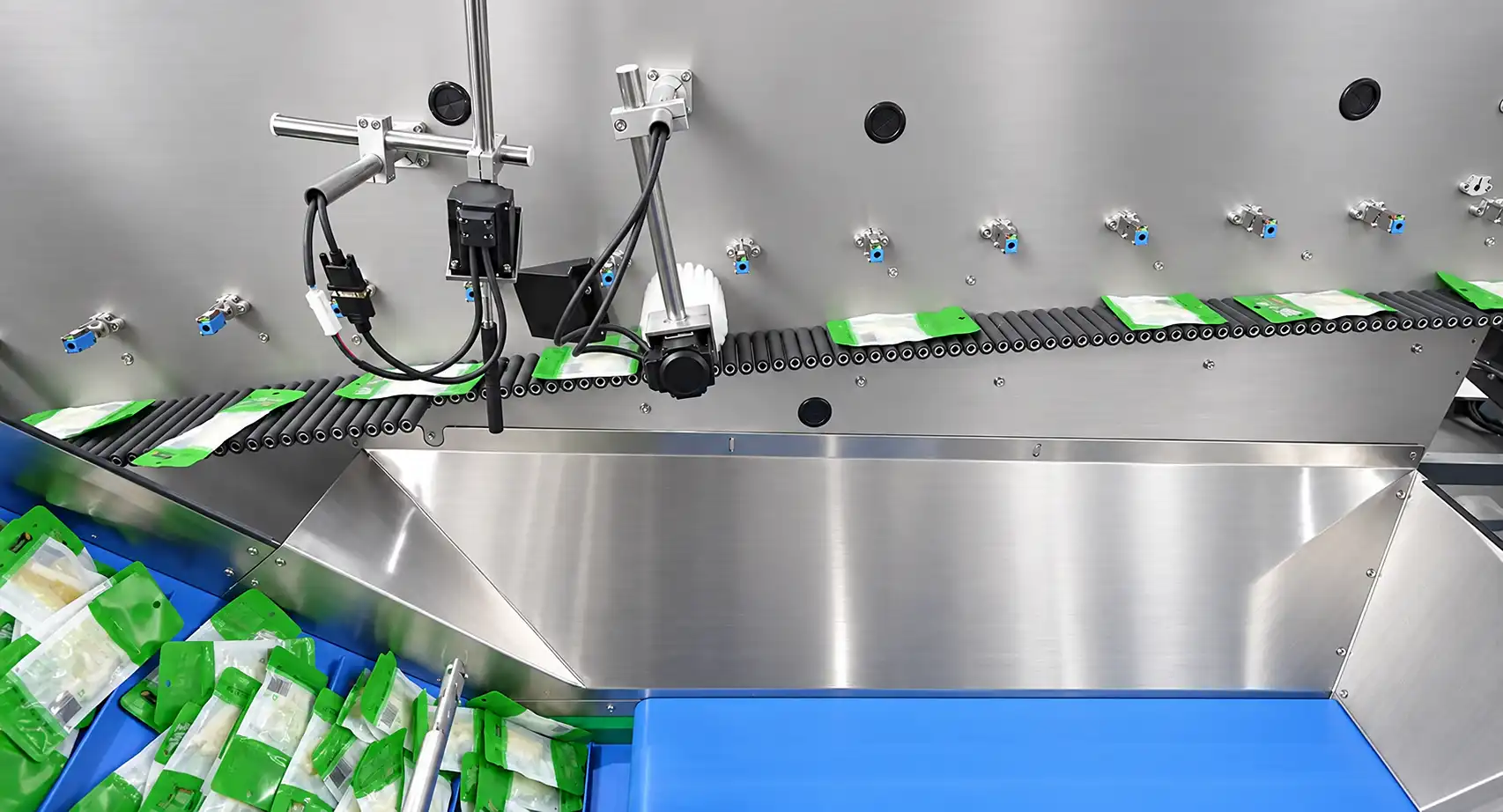
Sort the incoming packages
Photoelectric sensors monitor the incoming package flow and control the sorting action. The sorting machine arranges the packages; it does not create the final spacing.
STEP 3
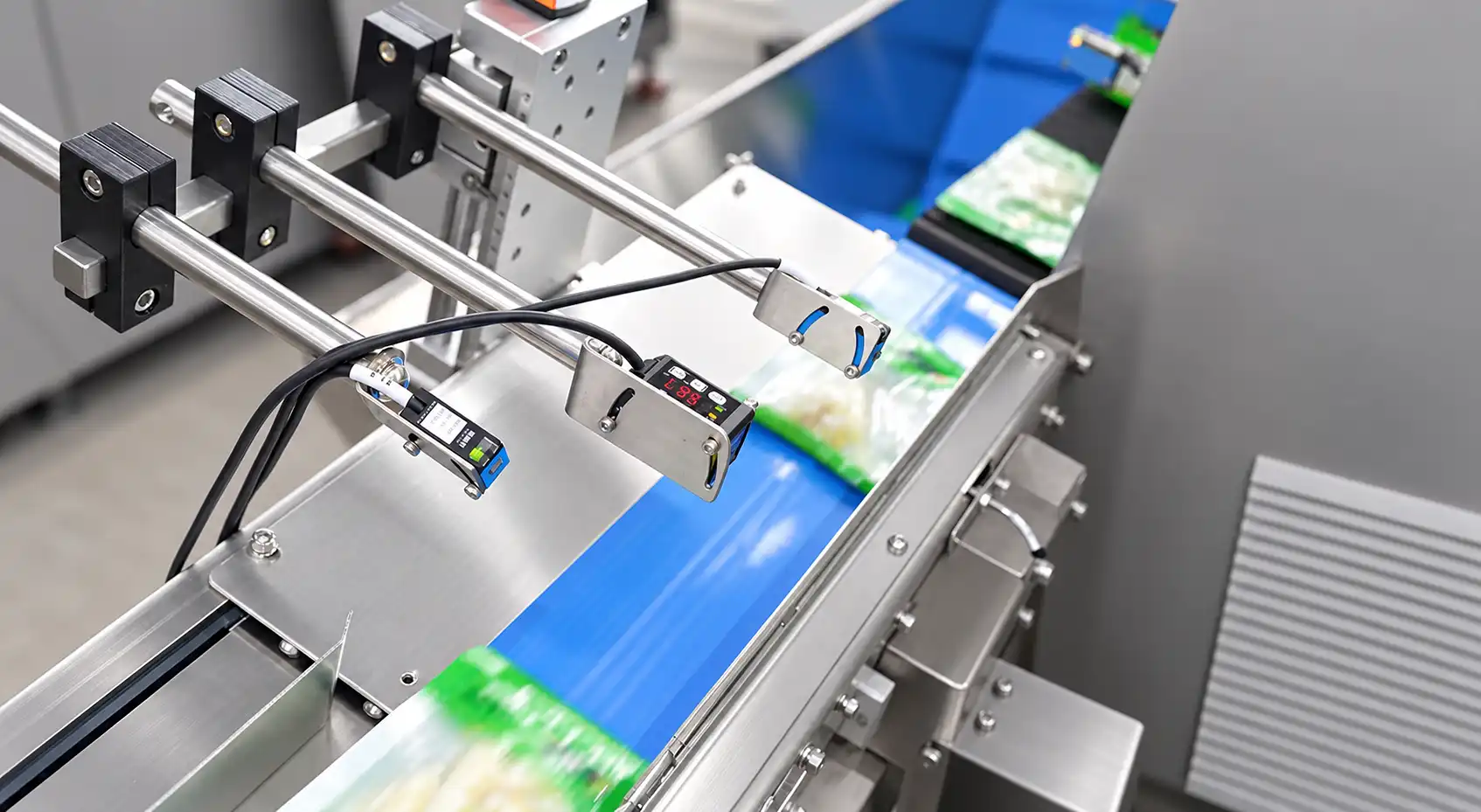
Create spacing and reject unsuitable packs
A differential-speed conveyor pulls packages apart. Detected tailgating, overlapped or crosswise packs can be rejected from the flow.
STEP 4
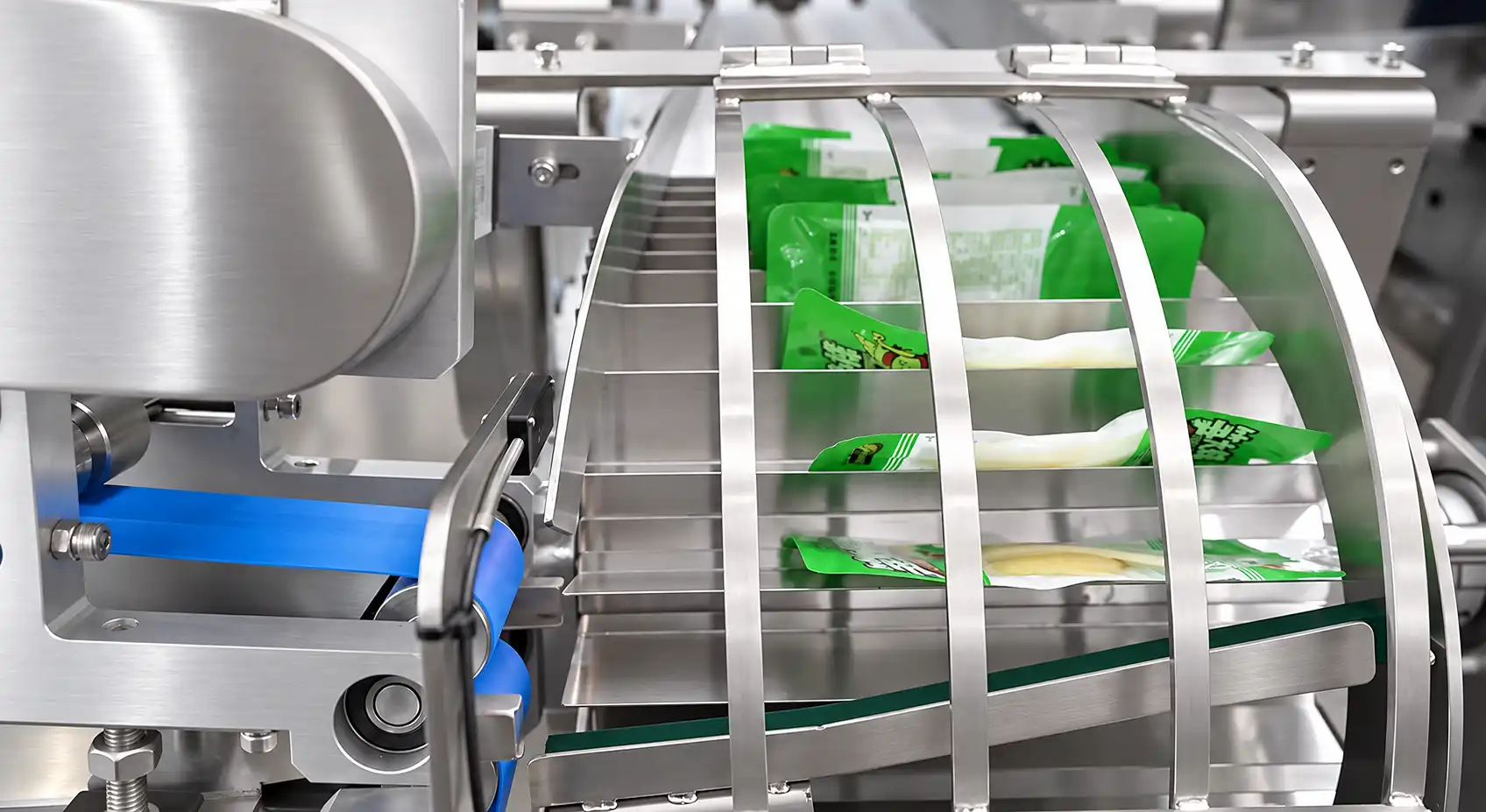
Count and transfer groups
Counted packages transfer to downstream equipment, such as cartoning machines, VFFS machines or premade pouch packing machines, depending on the actual project.
CONFIGURATION EXAMPLES
START WITH THE PRESENTATION REQUIRED BY THE NEXT MACHINE
Choose the package presentation your downstream equipment requires
The required output may be individual flexible package spacing, consistent pouch orientation, same-face grouping or an alternating pouch stack for cartoning. The selected output determines which handling modules need to be reviewed for the project.
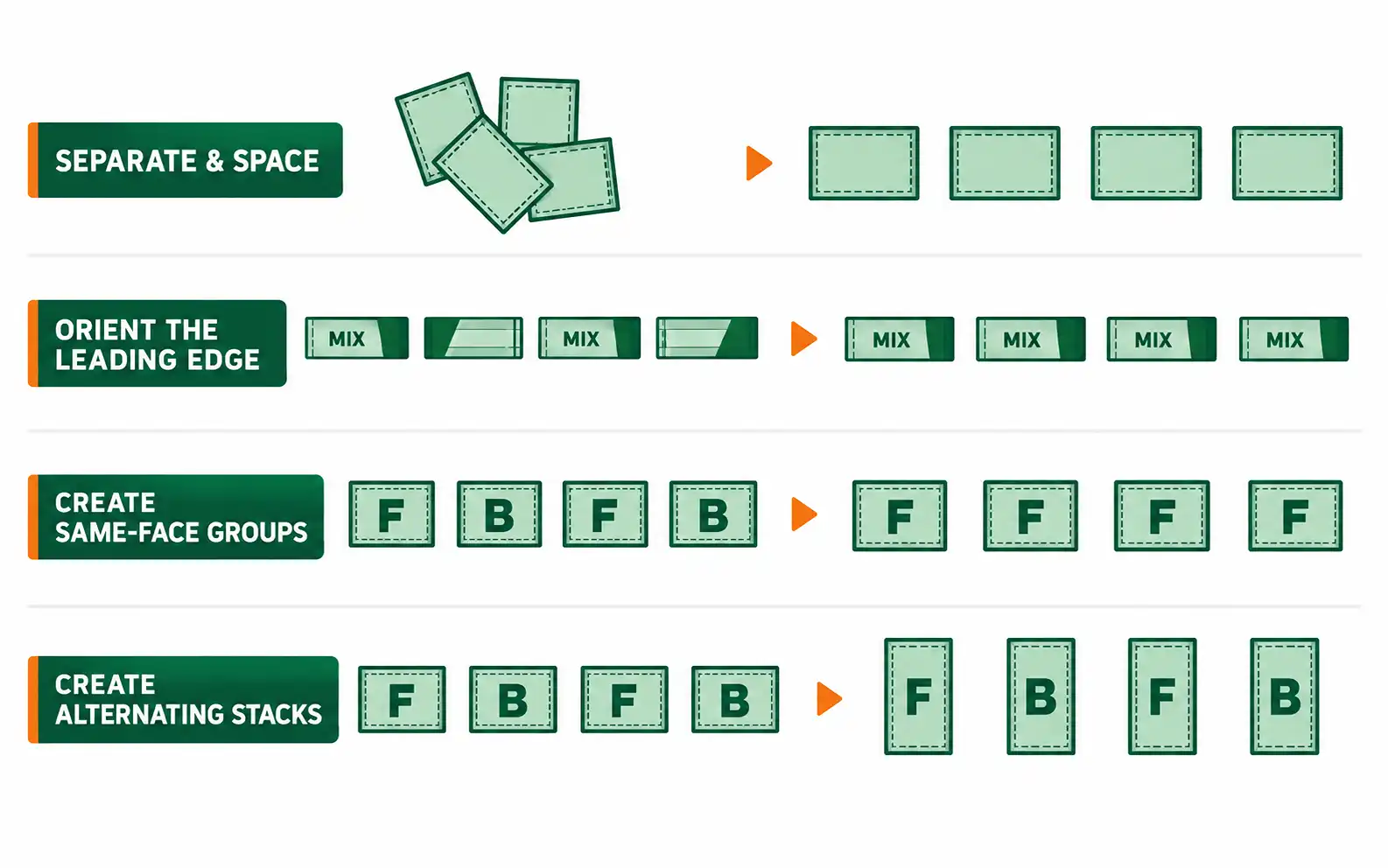
CONFIGURATION EXAMPLE 01
OUTPUT: INDIVIDUAL SPACED PACKS
Individual pack spacing
Finished packs arrive in an irregular flow and leave as individually spaced packages for the next handling step.
- Possible modules to confirm
- Differential-speed conveying, package detection and selected rejection handling.
- Downstream example
- Single-pack transfer to inspection, counting or secondary packaging.
CONFIGURATION EXAMPLE 02
OUTPUT: CONSISTENT LEADING EDGE
Leading-edge orientation
Packs can be prepared so the required leading edge arrives consistently at the next machine, even when the incoming flow is mixed.
- Possible modules to confirm
- Package detection, orientation control and the handling method required by the next process.
- Downstream example
- Controlled infeed to inspection, counting or a downstream transfer conveyor.
CONFIGURATION EXAMPLE 03
OUTPUT: UNIFORM POUCH FACE
Same-face pouch groups
Pouches enter with mixed front and back faces, then are prepared to reach the downstream equipment with the required presentation.
- Possible modules to confirm
- Vision inspection, spinning or face-alignment modules, and flipping where required.
- Downstream example
- Cartoning where each pouch in a group needs to face the same direction.
CONFIGURATION EXAMPLE 04
OUTPUT: ALTERNATING POUCH STACK
Alternating pouch stacks
When the carton-loading arrangement calls for alternating pouch faces or seal directions, the output stack is prepared around that requirement.
- Possible modules to confirm
- Vision inspection, flipping, stacking control and any required robotic orientation handling.
- Downstream example
- Cartoning with a defined alternating presentation inside the carton.
PACKAGE FORMATS
FORMAT REVIEW COMES BEFORE CONFIGURATION
Finished flexible package formats for sorting, orientation and counted transfer

Format review begins with the sealed package itself. Typical projects may involve flat sachets, stick packs, small pouches or other finished bags that need an orderly infeed to inspection, sachet counting, cartoning or another confirmed downstream process.
A compatible format is confirmed from the actual package, not from its name alone. Package dimensions, shape, stiffness, surface condition and incoming presentation affect the handling route and required output presentation.
Flat sachets and small bags
For sachet sorting, spacing or counted transfer after an upstream packing process.
Stick packs
For controlled stick pack transfer when the next process requires an orderly infeed.
Small premade pouches
For pouch orientation, same-face grouping or downstream cartoning presentation.
Stand-up and shaped pouches
Reviewed against the actual pouch profile, stability and required transfer route.
Spouted pouches
Reviewed around spout position, pouch balance and the next handling requirement.
Mixed or unusual package formats
Assessed with real samples before the handling modules are confirmed.
PROJECT CONFIRMATION
What we review before confirming the handling route
- Package size, shape and rigidity
- Surface and incoming condition
- Required count per group
- Output orientation
- Downstream infeed requirement
TECHNICAL REFERENCE
GENERAL REFERENCE RANGE BY SELECTED SERIES
Technical reference for bag sorting and counting systems
The following data provides a general reference for selected bag sorting and counting series. Final speed, package range, electrical supply, module quantity and machine layout depend on the selected configuration and are confirmed against the actual project.
GENERAL REFERENCE RANGE
Series reference for bag sorting and counting systems
Reference data only. The final specification depends on the selected configuration and is confirmed against the actual project.
| Reference item | Series 1 | Series 2 | Series 3 |
|---|---|---|---|
| Maximum speed | 300 pcs/min | 200 pcs/min | 200 pcs/min |
| Pouch length | 84–168 mm | 145–290 mm | 85–168 mm |
| Servo axes | 20 servos | 10–14 servos | 10–14 servos |
| Machine weight | 820 kg | 650 kg | 570 kg |
| Electrical supply | AC 380 V, 50 Hz — depending on the selected configuration | ||
Series 1
- Maximum speed
- 300 pcs/min
- Pouch length
- 84–168 mm
- Servo axes
- 20 servos
- Machine weight
- 820 kg
Series 2
- Maximum speed
- 200 pcs/min
- Pouch length
- 145–290 mm
- Servo axes
- 10–14 servos
- Machine weight
- 650 kg
Series 3
- Maximum speed
- 200 pcs/min
- Pouch length
- 85–168 mm
- Servo axes
- 10–14 servos
- Machine weight
- 570 kg
Electrical supply: AC 380 V, 50 Hz — depending on the selected configuration.
Send the finished package format, target count and downstream requirement for a configuration review. Final compatibility and technical data are confirmed against the actual project.
FAQ
COMMON QUESTIONS ABOUT BAG SORTING AND COUNTING
Bag Sorting & Counting System FAQs
Practical answers about finished package formats, sorting, counted transfer, pouch orientation, downstream integration and project confirmation.
What is an automatic bag sorting and counting system?What does a bag sorting & counting system do?
An automatic bag sorting and counting system handles finished flexible packages such as sachets, stick packs and pouches after they leave an upstream process. Depending on the selected configuration, it can help organise incoming packs, create a controlled transfer, count required groups and prepare them for the next packaging step.
What finished package formats can be reviewed?Which package formats can be reviewed?
Typical formats include flat sachets, small bags, stick packs, premade pouches, stand-up pouches and some shaped or spouted pouches. Compatibility is reviewed from the actual sealed package, including its dimensions, profile, stability, surface condition and incoming presentation.
Does the sorting machine create the final spacing between packages?Does sorting create the final pack spacing?
Not by sorting alone. The sorting function helps organise the incoming package flow. Where required, a differential-speed conveying stage is reviewed to pull packages apart and create a controlled gap for detection, counting or downstream transfer.
Can a sachet counting machine prepare a required number of packs per group?Can it count packs into required groups?
Yes, counting can be configured around the required number of finished packages in each group. The achievable count logic, transfer method and output condition depend on the selected configuration, package behaviour and the downstream process.
Can a pouch sorting machine orient mixed pouch faces?Can mixed pouch faces be oriented?
When the next machine requires a defined presentation, orientation handling can be reviewed. The selected project may require package detection, vision inspection, a spinning or face-alignment module, flipping, or another suitable orientation method.
Can overlapped, tailgating or crosswise packs be detected and rejected?Can overlapped or crosswise packs be rejected?
Package detection and selected rejection handling can be reviewed for incoming packs that are tailgating, overlapped or crosswise. The actual detection method and rejection arrangement are confirmed against the package sample and project conditions.
Can the system feed a cartoning machine or other downstream equipment?Can it feed a cartoner or downstream equipment?
It can be planned as an infeed stage for cartoning, inspection, secondary packaging or another confirmed downstream process. The required package orientation, count, transfer height and infeed condition need to be reviewed with the next machine.
What information is needed to confirm a suitable configuration?What is needed to confirm a configuration?
Please share the finished package sample or format, dimensions, package weight, incoming condition, required count per group, target presentation and downstream equipment requirement. This allows the handling route and technical reference to be confirmed against the actual project.
PROJECT CHECKLIST
REQUEST A BAG SORTING & COUNTING SOLUTION
Tell Us What You Know. We’ll Help With the Rest.
You do not need every specification confirmed. Send the information currently available, and we will review a suitable bag sorting and counting direction for your finished package and downstream packaging line.
USEFUL INFORMATION TO SHARE
- 01
Finished Package & Arrival ConditionPackage format, dimensions, surface condition and how packs arrive at the system
- 02
Required Count & OutputPacks per group, required spacing, orientation or stack presentation
- 03
Downstream EquipmentCartoning, inspection, secondary packaging or the required next-process infeed
- 04
Available SamplesPackage photos, samples, drawings, equipment details or line-layout files
Prefer to contact us directly?
