
AUTOMATIC END-LOAD CARTONING
Horizontal Cartoning
Machines
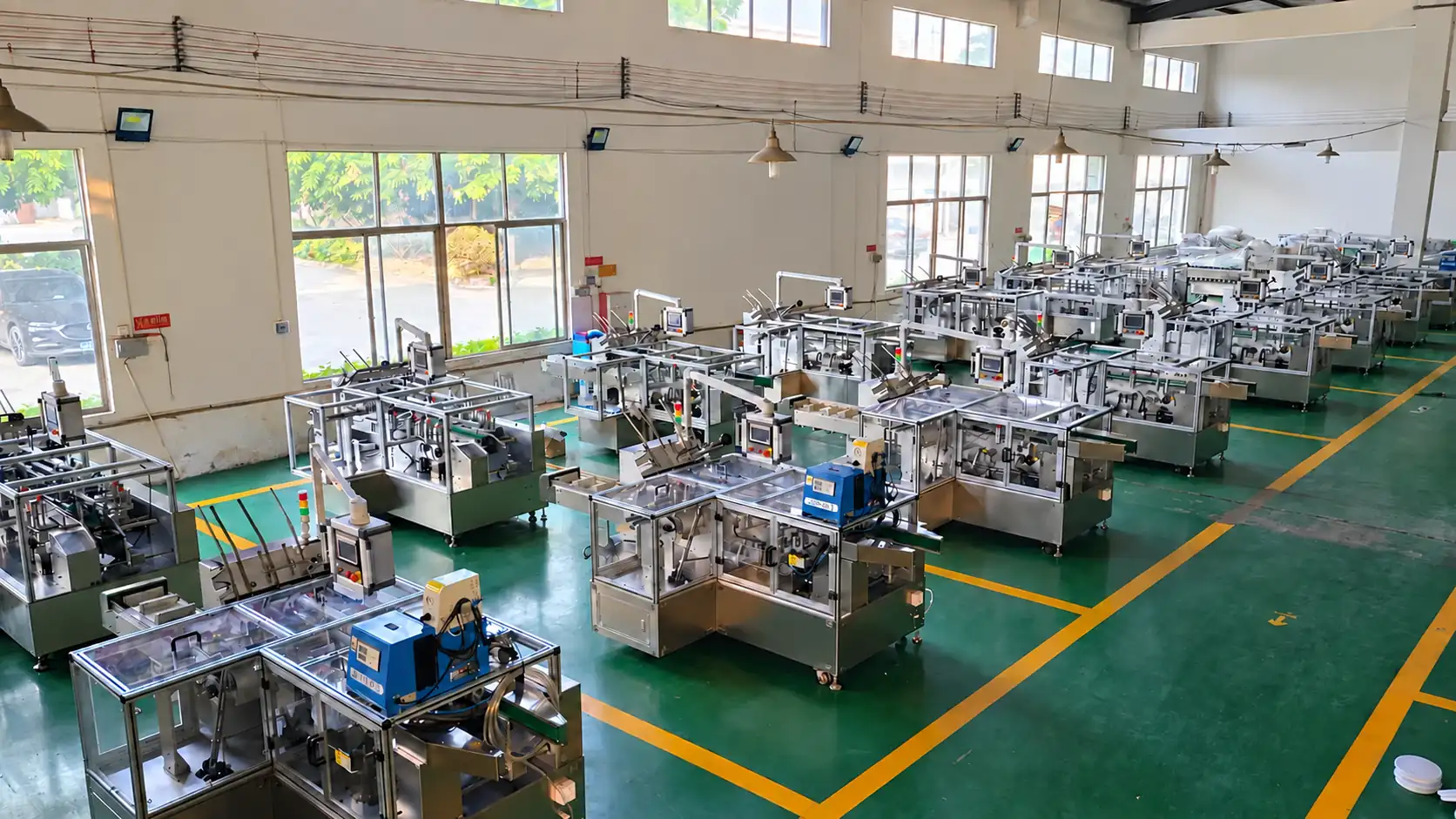
Erect flat carton blanks, load products horizontally and close each carton with a tuck-in or glue-sealed method. Every system is configured around the product, carton dimensions, feeding method and required output.
- HORIZONTAL PRODUCT LOADING
- TUCK-IN OR GLUE CLOSING
- PROJECT-SPECIFIC LINE INTEGRATION
MACHINE OVERVIEW
AUTOMATIC HORIZONTAL CARTONING
Automatic Horizontal Cartoning for End‑Load Cartons
A horizontal cartoning machine is an automatic carton packing system that erects a flat folding carton, loads one product or a prepared product group through the open end, and closes the carton with tuck-in flaps or hot-melt glue. The suitable feeding and loading arrangement depends on how the product arrives, its orientation, the quantity per carton and the carton structure.
A GOOD FIT WHEN
The product can be consistently oriented, grouped and presented for horizontal end-load cartoning. Finished bags, sachets or stick packs can be prepared before transfer by integrating an automatic bag sorting and counting system when required.CONFIRM BEFORE SELECTION
Confirm the product arrival, quantity per carton, loading orientation, carton dimensions and closure method before the machine configuration is finalized.Carton Feeding & Erecting
Flat carton blanks are separated from the magazine, opened and held in position for product loading.
Product Feeding & Loading
A single product or prepared product group is aligned with the carton and loaded horizontally through its open end.
Closing & Discharge
The carton flaps are folded and secured by the selected tuck-in or hot-melt glue system before discharge.
HOW TO SELECT A CARTONING MACHINE
Start with the Product, Carton and Line
Machine selection begins with the actual pack and production conditions. Carton dimensions alone are not enough to confirm a reliable configuration.- Product & Load
- Dimensions, shape, stability, quantity per carton and the required loading orientation
- Carton Format
- Carton style, dimensions, paperboard condition, flap arrangement and closing method
- Line & Output
- Product arrival, feeding or grouping method, required output and upstream or downstream equipment. Sustainable output is evaluated from the complete packaging process—not the cartoner’s nominal speed alone.
Final configuration check: machine suitability is confirmed against the actual product, carton sample or dimensioned drawing, loading arrangement and required production output.
CARTON FORMATS
END-LOAD CARTON FORMATS & CLOSING OPTIONS
Carton Formats & Closure Options
A horizontal cartoning machine erects a pre-folded carton, loads the product through an open end and closes the carton. The carton structure and closing method are selected around the product, loading arrangement and required finished-pack presentation.

MECHANICAL FLAP CLOSURE
NO ADHESIVETuck-In End Closure
Straight tuck-end and reverse tuck-end carton formats can be evaluated according to the approved carton design. Project-specific glue application can also be integrated when required.CONFIRM FOR YOUR CARTON
- Flap geometry
- Crease quality
- Board stiffness

ADHESIVE FLAP CLOSURE
HOT-MELT GLUEHot-Melt Glue End Closure
Multiple glue-sealed flap arrangements can be evaluated. Adhesive position, flap folding and compression are configured around the approved carton structure and board surface.CONFIRM FOR YOUR CARTON
- Glue area
- Board coating
- Compression sequence

PRE-GLUED LOCKING BOTTOM
ERECTION TESTAuto-Lock Bottom / Crash-Lock Bottom
The pre-glued bottom panels lock into position as the carton is erected. The carton erecting arrangement is configured around the approved bottom structure, carton sample or dimensioned dieline.CONFIRM FOR YOUR CARTON
- Bottom geometry
- Pre-glue quality
- Erection test
PRODUCTS & APPLICATIONS
PRODUCT-SPECIFIC CARTONING
Products an Automatic Cartoning Machine Can Pack
An automatic cartoning machine loads products into folding cartons after they have been oriented, counted or grouped for controlled insertion. The suitable product range depends on the infeed system, carton format, loading arrangement and the actual project requirements.
APPLICATION RANGE
Configured Around the Product—not Limited to These Examples
Cartoning feasibility is determined by the actual product, infeed condition, carton format and loading arrangement—not by a fixed industry list. The examples below show selected projects; product suitability is confirmed against representative samples.
- Blisters & strips
- Bottles & vials
- Tubes
- Sachets & pouches
- Stick packs
- Wrapped food
- Cosmetics
SELECT A RELEVANT PROCESS EXAMPLE
Use the tabs to compare similar loading conditions. These videos illustrate individual projects, not a fixed machine application list.
YOUTUBE PROCESS EXAMPLE
Cereal bar cartoning processCEREAL, GRANOLA & SNACK BARS
EXAMPLE 01Wrapped Bar Cartoning
For wrapped bars presented consistently for loading and closing. Configuration is reviewed against pack dimensions, arrival direction and quantity per carton.
- Cereal bars
- Granola bars
- Protein bars
- Energy bars
- Wrapped snack bars
Wrapper discharge, bar spacing, orientation and the required collation pattern.
YOUTUBE PROCESS EXAMPLE
Bottle and leaflet cartoning processPHARMACEUTICAL BOTTLES & LEAFLETS
EXAMPLE 02Bottle Cartoning with Leaflet Insertion
For bottles loaded with folded leaflets. The container profile, cap direction, leaflet format and carton orientation define the required arrangement.
- Medicine bottles
- Nutraceutical bottles
- Small containers
- Folded leaflets
- Carton inserts
Bottle orientation, leaflet synchronization, carton loading and presence checks.
YOUTUBE PROCESS EXAMPLE
Ice cream cartoning and case packing processICE CREAM & FROZEN TREATS
EXAMPLE 03Cartoning and Case Packing Line
For wrapped frozen products organized before cartoning and downstream case packing. The line is reviewed around discharge, orientation, grouping and case pattern.
- Wrapped ice cream
- Frozen treats
- Flow-wrapped products
- Multipack cartons
- Case packing
Product organization, carton grouping and transfer to downstream case packing.
WORKING PROCESS
FROM FLAT CARTON TO FINISHED PACK
How an Automatic Cartoning Machine Works
The cartoning machine working principle is a controlled sequence: separate and erect a folding carton, present the product for end loading, close the carton and transfer the finished pack for inspection or downstream handling.
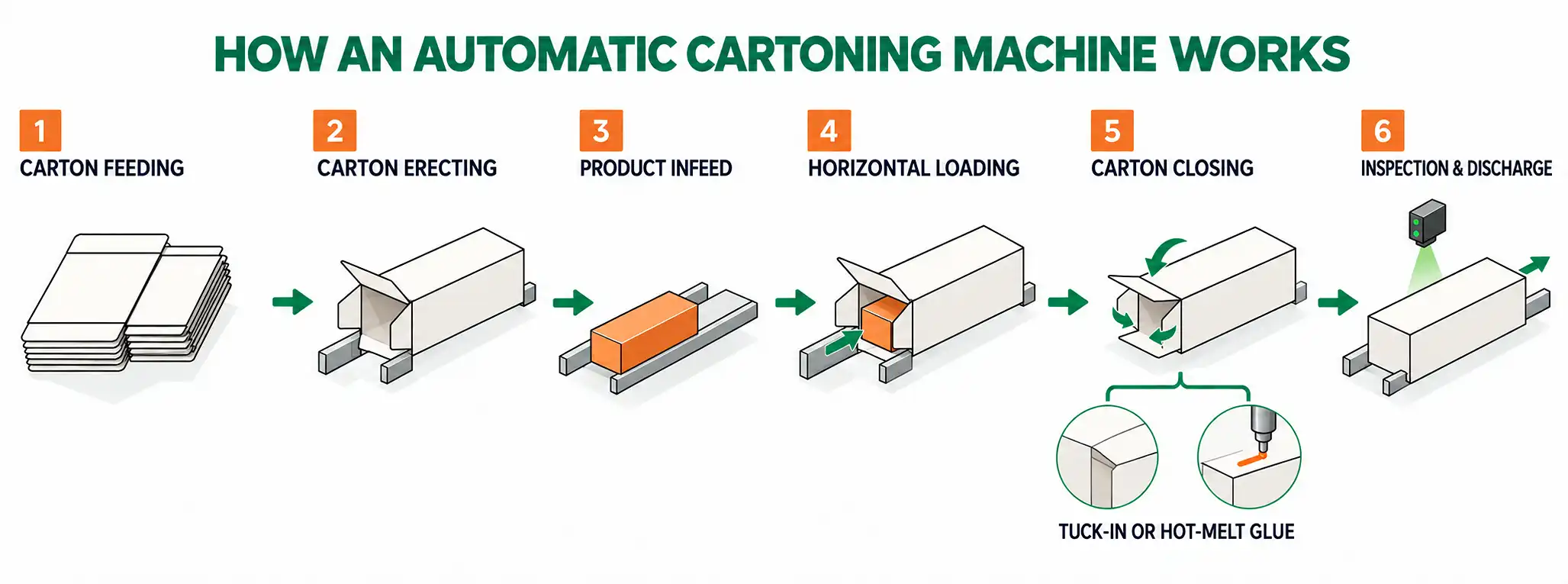
Open the diagram at full size, or select a stage below to review its function and main control points.
Carton Feeding
Flat folding cartons are separated from the magazine and transferred toward the erecting station.
- Key control
- Magazine setup, carton-blank condition and reliable single-carton separation.
Carton Erecting
The carton blank is opened and held with its loading end correctly presented.
- Key control
- Pickup reliability, crease condition, carton squareness and open-end position.
Product Infeed
The product is oriented, spaced, counted or grouped for the approved carton-loading arrangement.
- Key control
- Arrival direction, spacing, orientation, quantity per carton and grouping method.
Horizontal Loading
The prepared product or product group is pushed through the open end of the erected carton.
- Key control
- Product stability, loading clearance, pusher timing and carton-to-product fit.
Carton Closing
Dust flaps and closure panels are folded, then secured by the approved tuck-in or hot-melt glue method.
- Key control
- Flap geometry, crease quality, adhesive position and the required compression sequence.
Inspection & Discharge
The closed carton is discharged. Coding, presence checks and downstream transfer can be integrated when required.
- Project-specific
- Inspection method, reject logic, coding position and downstream equipment interface.
OPTIONS &
LINE INTEGRATION
BUILD THE CARTONING SYSTEM AROUND THE PROJECT
Optional Functions & Cartoning Line Integration
Automatic cartoning machines can be combined with product handling, carton closing, coding, inspection and line-transfer functions. The required cartoning equipment is selected only after the actual product, carton and production sequence have been reviewed.
PRODUCT INFEED & LOADING
Prepare the Product for Controlled Carton Loading
The infeed is developed around how the product arrives and how it must be oriented, counted or grouped before loading. The final arrangement should be confirmed with representative product and carton samples.Bag Sorting & Counting
Finished bags, sachets or stick packs can be separated, oriented and counted before transfer to the cartoner when a suitable system is confirmed.
Explore Bag Sorting & Counting →Product Counting & Grouping
Products can be counted, stacked or collated into the approved quantity and loading pattern before horizontal insertion.
Leaflet or Insert Handling
A folded leaflet or other approved insert can be synchronized with the product when required by the pack configuration.
CARTON FINISHING
Match the Closing and Coding Method to the Carton
Closure geometry, board condition, code location and available machine space are reviewed before these functions are selected.Tuck-In Closing
Mechanical flap folding and tuck-in closing can be configured for an approved straight or reverse tuck-end carton design.
Hot-Melt Glue Closing
Glue application and compression can be integrated according to the approved flap arrangement, board surface and glue area.
Date or Batch Coding
A suitable coding unit can be positioned to apply the required production information at a confirmed location on the carton.
QUALITY-CONTROL POINTS
Add Inspection Where the Process Requires It
The inspection method, reject logic and verification standard are defined for the actual product and carton—not assumed from a generic machine layout.Product & Carton Presence Detection
Detection points can be evaluated to confirm product presentation, carton presence or completion of a required loading event.
Barcode or Code Inspection
Barcode, printed-code or related vision checks can be considered when the inspection target and acceptance criteria are defined.
Checkweigher & Reject Handling
Closed cartons can be transferred to suitable weighing and rejection equipment when final-pack verification is required.
Explore Inspection Equipment →UPSTREAM & DOWNSTREAM CONNECTIONS
Plan the Cartoner as Part of the Complete Packaging Line
Transfer height, product timing, accumulation, control signals and the required downstream pack are confirmed before the final line layout is defined.Packaging Machine Connection
Wrapped products, pouches, sachets or other finished primary packs can be transferred from compatible upstream equipment.
Conveying, Buffering & Transfer
Project-specific conveying and accumulation can support stable product flow between machines where the process requires it.
Case Packing or Secondary Handling
Finished cartons can be transferred toward checkweighing, case packing or another approved downstream process.
REFERENCE LINE ROUTE
From Primary Pack to Downstream Automation
This route shows possible connection points. It is not a fixed equipment scope.- UPSTREAMPrimary Packaging Equipment
- PRODUCT PREPARATIONFeed, Orient, Count or Group
- CORE PROCESSHorizontal Cartoning Machine
- QUALITY CONTROLInspect, Weigh or Reject
- DOWNSTREAMCase Packing or Line Discharge
BUYER FAQ
BEFORE CONFIGURATION & QUOTATION
Cartoning Machine FAQs
Practical answers about production output, format range, sample testing, project scope and after-sales support for an automatic cartoning machine.
01How Is the Required Cartoning Speed Determined?
Sustainable output is evaluated from the complete packaging process. Product arrival rate, orientation, quantity per carton, feeding and grouping method, carton quality, closure, inspection and upstream or downstream equipment can all affect the achievable production speed.
02Can One Cartoning Machine Handle Multiple Products and Carton Sizes?
Potentially, provided every product and carton remains within the machine’s confirmed format range. The required change parts, adjustments and changeover procedure depend on the differences in product geometry, loading pattern, carton dimensions and closure method.
03Should Product and Carton Samples Be Tested Before the Machine Is Finalized?
Yes. Representative products, physical cartons and the approved carton dieline help verify feeding, orientation, loading clearance, carton erecting, flap folding and closure. Drawings can support a preliminary review, but the final configuration should be based on approved samples whenever possible.
04What Information Is Needed for Configuration and Quotation?
Please provide product photos, dimensions or samples; the carton dieline and samples; quantity and orientation per carton; product-arrival condition; closure method; target output; required coding or inspection; and details of connected upstream and downstream equipment.
05What Determines the Price of an Automatic Cartoning Machine?
Cartoning machine price depends on the product infeed, loading arrangement, output requirement, carton format, closure method, number of change formats, coding and inspection functions, safety or destination requirements and the overall line-integration scope.
06How Much Floor Space Does the Cartoning System Require?
The footprint depends on the cartoner, product-feeding system, carton magazine, optional inspection equipment, conveyors and maintenance access. Provide the available floor area, product-flow direction, transfer heights and nearby equipment so a project-specific line layout can be reviewed.
07What Is the Difference Between a Cartoning Machine and a Case Packer?
A cartoning machine loads an individual product or prepared product group into a folding carton. A case packer places multiple finished products or cartons into a larger shipping case. A complete secondary packaging line may use both processes in sequence.
08What After-Sales Support Is Available?
The machine is covered by a 12-month warranty from the date it is received. A one-year spare-parts package is supplied according to the confirmed machine configuration. Remote technical support is available, and paid on-site installation and commissioning services can be arranged when required.
PROJECT CHECKLIST
REQUEST A CARTONING SOLUTION
Tell Us What You Know. We’ll Help With the Rest.
You do not need every specification confirmed. Send the information currently available, and we will review a suitable cartoning-machine direction for your product, carton and production line.
USEFUL INFORMATION TO SHARE
- 01
Product & Arrival ConditionProduct dimensions, orientation and how it arrives at the cartoner
- 02
Carton Format & SizeCarton style, finished dimensions and closing method
- 03
Quantity & Target OutputProducts per carton and required cartons per minute or hour
- 04
Available SamplesProduct photo, carton dieline, sample carton, insert or line-layout drawing
Prefer to contact us directly?
