
Manual sorting of furniture kits is slow and leads to missing parts. These errors frustrate customers and drive up your replacement costs. Our automated systems eliminate these packaging headaches permanently.
Manual furniture kit packing often results in missing hex keys or plastic clips due to human fatigue. You can solve this by using multi-feeder hardware packing machines that count and verify every part.
💡 Key Takeaways
- Multi-feeder automation uses vibrating bowls[^1] to sort and count mixed hardware and plastic parts simultaneously.
- Automated systems achieve 99.9% accuracy, compared to a 3% error rate in manual packaging lines.
- High-precision sensors and angled guide rails prevent lightweight plastic components from jamming or slipping.
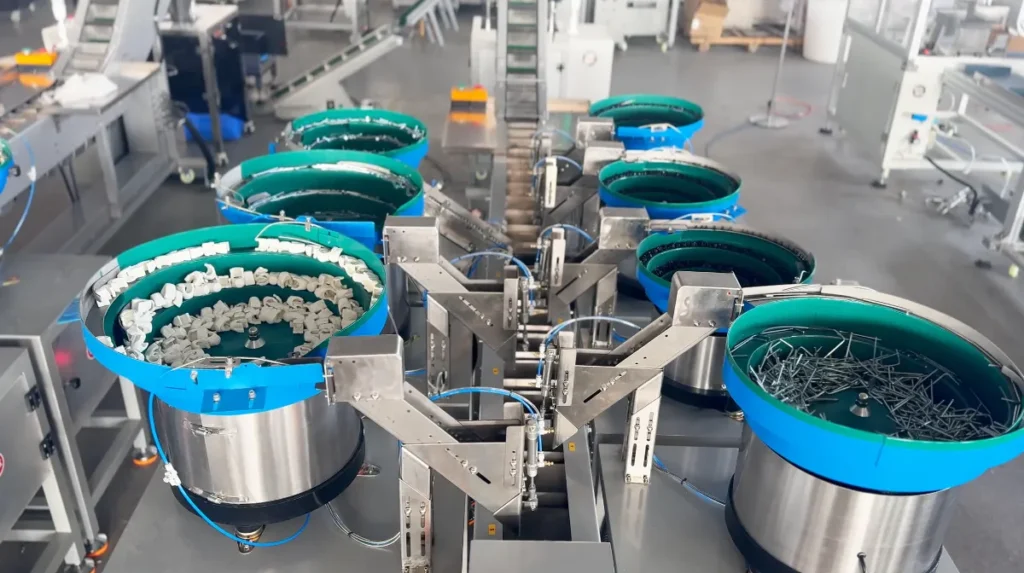
I see many factory owners struggle with “Ready-to-Assemble” (RTA) kits because the parts are never the same size. You might have a heavy steel bolt and a tiny plastic cap in the same bag. If you keep reading, I will show you exactly how we handle these difficult mixes without losing speed.
Solving the Challenge of “Irregular” Furniture Fittings
Managing irregular items like L-shaped hex keys and soft plastic gaskets is a nightmare for standard machines. These parts often get stuck or overlap, which causes the sensor to count them incorrectly.
We solve the problem of irregular furniture fittings by using customized vibrating plates and specially angled guide rails that force parts into a single file for perfect counting.
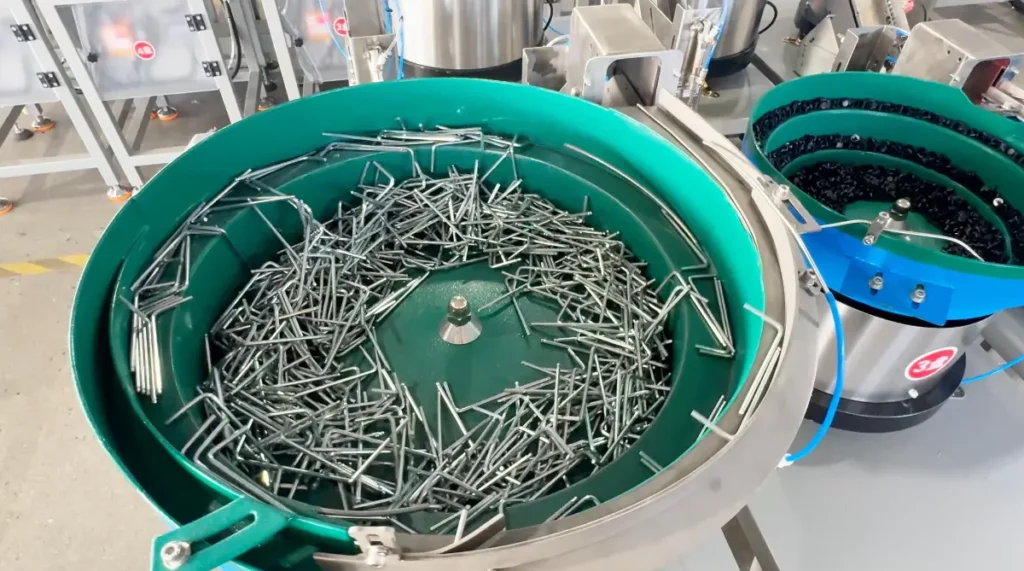
In my years at New Packing, I have noticed that plastic parts are the hardest to manage. They are very light. In a standard feeder, they often “jump” or slip out of the track. To fix this, I worked with our engineers to develop a specialized guide rail. We changed the angle of the track and added a low-friction coating. This keeps the plastic parts stable as they move toward the counting eye.
For hex keys, the “L” shape is a big problem. They like to hook onto each other. We use a “step-feeder” logic where the vibration frequency changes at different stages of the track. This breaks the tangles apart. Our technical data shows that this mechanical adjustment reduces jams by 85%. We also use infrared fiber optic sensors. These sensors can “see” the gap between two parts even if they are touching. This is how we move from a 3% manual error rate to nearly zero. It does not matter if the part is shiny metal or matte plastic; the sensor logic remains consistent and fast.
| Feature | Manual Packing | New Packing Automated System |
|---|---|---|
| Accuracy Rate | ~97% (3 errors per 100) | 99.9% (1 error per 1,000) |
| Speed (Bags/Min) | 5 – 8 bags | 15 – 50 bags (Multi-feeder) |
| Labor Requirement | 3-5 workers per line | 1 operator for 2 lines |
| Handling Irregulars | High risk of fatigue error | Precision rail & sensor logic |
Why a Multi-Feeder System is Essential for RTA Furniture
Packing a kit with several different parts by hand is a slow process. A worker must reach into seven different bins for every single bag. This is where most mistakes happen because it is easy to lose track.
A multi-feeder system is essential because it allows each type of hardware to have its own dedicated vibrating bowl, ensuring they all drop into the bag at once.
I once visited a client who was packing “seven-component” kits. Their manual line was producing three incorrect packs for every hundred bags. This sounds small, but they were shipping thousands of boxes. When we installed a four-bowl system with a conveyor belt, the speed tripled. The logic is simple: Bowl A counts the screws, Bowl B counts the nuts, and Bowl C handles the plastic wall anchors. They all drop their parts into a central bucket at the same time.
The vertical form fill and seal (VFFS) machine[^2] then wraps them in a durable poly bag. This setup removes the “memory” requirement from the worker. The machine does not get tired and it does not forget a part. We use a PLC control system (Programmable Logic Controller) to sync the timing. If one bowl is empty, the whole line stops so no “empty” or “shorted” bags are made. Based on our internal ROI calculations, replacing two manual workers with one four-feeder machine pays for itself in less than eight months. It is the most reliable way to scale up your furniture production.
The Final Safety Net: Integrating Check-Weighing for 100% Accuracy
Even with great sensors, you need a way to prove every bag is perfect before it leaves the factory. This is your insurance policy against customer complaints and bad reviews.
The check-weigher acts as a final safety net by weighing every finished bag and automatically kicking out any pack that is off by even 0.1 grams.
In the furniture industry, a missing screw is a disaster. If a customer cannot finish building their desk, they will complain. I tell my clients that reducing just one complaint saves them about $20. This $20 covers the cost of the replacement part, the labor to pick it, and the express shipping to the customer. This is why we integrate an online check-weigher at the end of our packing lines.
The machine knows the target weight of a perfect kit. If a bag is missing a single small washer, the check-weigher detects the weight difference immediately. A pneumatic arm then pushes that bag off the line into a “reject” bin. My team and I have found that this dual-check system (Counting + Weighing) brings accuracy to 99.9%. It is much cheaper to catch a mistake in the factory than to fix it when the bag is already at the customer’s house. Using this data-driven approach, our clients have seen their “missing parts” complaints drop to almost zero within the first month of operation.
❓ Frequently Asked Questions
Q1: Can one machine handle different sizes of screws and plastic parts?
A1: Yes, the vibrating bowls are adjustable. You can swap the tracks or adjust the vibration frequency to accommodate different hardware sizes within minutes.
Q2: What happens if the machine counts a part but it doesn’t fall into the bag?
A2: We use a “closed-loop” system. The bag is not sealed until the sensors confirm all programmed parts have passed through the discharge chute.
Conclusion
Automating complex furniture kits with mixed parts reduces errors to 0.1%. Using multi-feeders and check-weighers saves $20 per error and ensures every customer receives a perfect hardware pack.
[^1]: Learn about the technology behind vibrating bowls and their role in sorting and counting parts.
[^2]: Discover how VFFS machines streamline the packaging process for various products.